Seeing as it’s the end of a calendar year and we are turning the page, it works out that it’s also been almost an entire year since I was diagnosed Autistic / ADHD – AuDHD if you will. I really can’t explain that the way the words form in my head while laying awake in the dark early hours of the morning just. don’t. come. out the same on virtual paper. I wish they did, but then I may have a thesis every time I want to explain an idea. A girl’s gotta work and do laundry, you know.
That said, I’ll try to get some thought out in a coherent manner… I’ve spent the majority of this (almost last) year learning what it means to be Autistic / ADHD. Being late-diagnosed at almost 40 years old has its own challenges, and its own blessings too. I’m one of many graduates of 90’s gifted / talented programs who is probably reeling from this diagnosis or self-realization.
Come settle down, settle down // let loose your glow (“Technicolour Beat, Oh Wonder”)
On the other side of the diagnosis is the disability. I’ve been doing my own research into the medical and social models of disability to understand where my experience sits. I think, because of the ramifications of the social model of disability, I am disabled by my environment and by society. I can just hear the voices now trying to invalidate my experience, but from what I’ve learned, discovered, and lived in the past year (and now reflecting on my life thus far), I can tell you, this is true.
If you’ve been around any neurodivergent spaces online or elsewhere, you may have heard of “unmasking”. I’m an educator by trade, and as such I learned all about Maslow’s Hierarchy of Needs (linked) – and I want to use it as a framework for my own unmasking journey. Initially I pictured unmasking as a monolith or amoeba, even though I know it’s complicated and nuanced.. I just didn’t yet have the context to categorize my lived experiences.
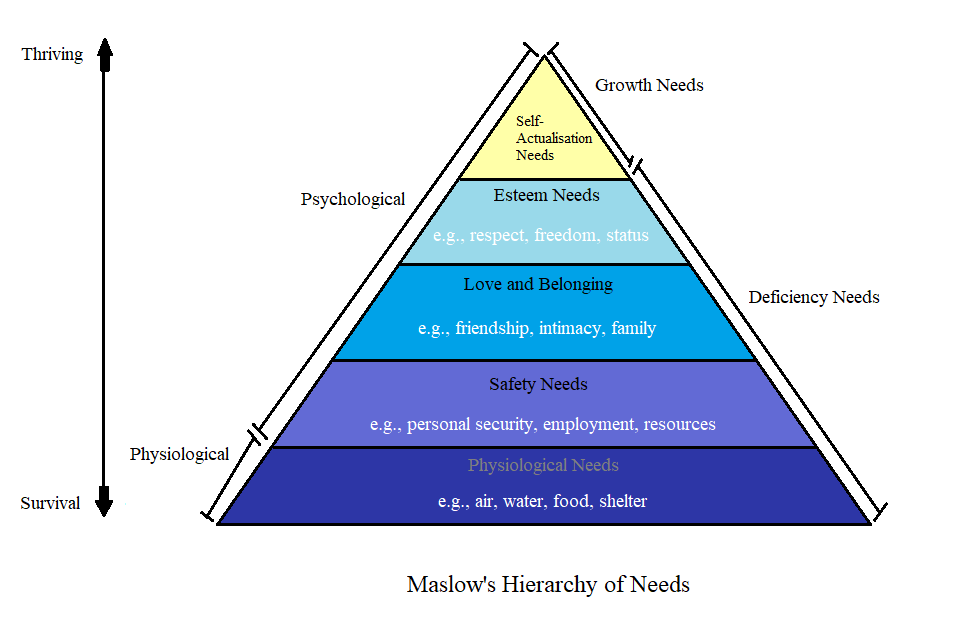
Without planning it or realizing it at first, I’ve been spending this year attending to many of these needs, not necessarily satisfying all of them in one layer before moving to the next – my experience has been more spiral than linear. At first, this looked like angrily ripping off a shirt that just wasn’t doing it for me, only to leave the house 5 minutes later overheated, upset, and despite changing, still not feeling totally comfy to go sit in an office all day.
Slowly this seemingly simple process of getting ready in the morning has morphed into a routine that leaves me hardly phased at all by the time I leave the house. It started with being extremely mindful and honest with myself about the clothes and shoes I was bringing into my closet. I’m also tall, have broad shoulders, and I’m busty, so it’s a challenge in general to find clothes meet in that tiny Venn diagram center of “comfortable”, “reasonably priced”, and “fits well”.
For me, this has looked a lot more like oversized sweaters / sweatshirts, jeans that actually fit and aren’t one size too small (as an Elder Millennial I suffer from cutting my teeth on Spandex’d skinny jeans ). This looks like no heels or dressy shoes at all, and all the versions of Adidas sneakers plus some comfortable ankle boots. Admittedly, my work environment is much more conducive to this more relaxed style than it used to be (manufacturing versus teaching), so that makes it easier to fully adopt this style of dress. I also put a fan in my vanity area and use it when I’m starting to feel overheated.
In accommodating my needs in the morning, it sheds light on some reasons why getting ready growing up was so stressful. Put three neurodivergent teenage girls in a tiny bathroom together and you’re bound to have some issues! I can’t tell you how many meltdowns I had just trying to get my contact lenses in, and then having witnesses to call me out when I was getting frustrated.
Interestingly, the style of dress is not newly adopted – it’s rediscovered as the way I preferred to dress as a kid, before I became a teenager. Looking back at pictures of myself, I liked soft pants, oversized shirts, and layers with flannel shirts. And that’s so much of what I’m discovering in my unmasking post-dx — my inner child before encountering the pressures of adolescence and adulthood.
The intersectionality of unmasking in light of my diagnosis cannot be ignored or one-sided. When I’m dressing more for my comfort and literal ability to concentrate when at my desk or at a social event, or even at home, I also am thinking about what this means as a woman who’s been conditioned my whole life that I owe it to someone (who? I have some ideas) to look my “best” or to show off my “features”.
This goes for makeup and hair too. I’m going gray and wavy and loving it, and haven’t bleached or colored my hair for at least a couple years now. I’ve never been big on makeup – tinted moisturizer with sunblock, waterproof mascara, and Burt’s Bees does me good. I might wear a little blush or neutral eyeshadow when going out. And for years and years I vowed to learn how to properly do my makeup, to you know, really allow my icy blue eyes to “pop”. For years and years, really decades, I felt that I wasn’t doing enough to be feminine or as attractive as I could be. It really weighed me down, and I’m happy to report that I’m finally breaking out of that and feeling comfortable in my skin and body, as I did when I was a child. Before I got tall and “developed”.
And then, when I think about presenting more “feminine” (who defines this anyway?!), I think about how I already have a few marks against me as bucking gender norms since I don’t have children (child-free not by choice, read about it here) and don’t have anything but one lone ovary left after a hysterectomy 3.5 years ago. So then, I’m re-processing my experiences of infertility, endometriosis, and hysterectomy from a different angle.
But see, these are the mental gymnastics my brain is involuntarily taking me through as I hold up each piece of my mask and examine it from all angles before discarding or changing it (yes there are parts of my mask that I need to keep, more on that later). It’s exhausting, and maybe in future posts I will talk about how this diagnosis-to-unmasking pipeline caused a secondary AuDHD burnout that took up the first part of my year in 2025.

 MPM 2.0: mercy unmasked